Perhaps the most dystopian thing I’ve written so far. I can’t help but wonder about our future as human beings. AI and software engineering has surpassed doing tasks at a linear level. Claude Opus 4.8 makes context-level mistakes. It doesn’t understand where it’s at sometimes. You legitimately do need to guide it to get where you need to go. Fable 5 is a different beast and really exposes the future of AI in the workforce and exactly how disruptive it is to everything, in my opinion.
AI and jobs
First of all, debunking the common misconception: well, if AI is going to replace everything, why do I still have a job? The answer is extremely simple: Fable 5 and similarly equipped models are a little bit too expensive for us right now. But like every single piece of technology ever imagined, it gets cheaper and more cost-effective as people find better ways to implement it. Think about how far we’ve come in TVs, in cell phones, in any electronic device that you’ve used in the past 10 years. TVs used to be pretty bad, and those are now basically given away on Black Fridays. It’s only a matter of time before Fable five becomes a commodity, something that everyone just has access to because it’s so affordable. Even though that’s not the case right now, there’s no way that it won’t be the case. There’s no way that somebody wouldn’t take the time to figure it out. It’s just worth too much money to not figure out.
With that said, again, in these blog posts I try to explain just how powerful Fable 5 is, but it can get a bit confusing when you start comparing the models, especially when there exist a lot and there have been a lot of legitimately powerful progressions in the past year alone. Let me say this in the most simple way I can. Fable 5 is a replacement for an engineer. That isn’t really up for debate. Not only can it do incredibly linear tasks, but it has context. It thinks like we do. It can spot errors on its own. It doesn’t need human intervention to continuously improve software. It just does it because it knows how to do it. All of this is because of what I believe and what I’ve talked about for the past year on this blog as the context issue: LLMs are language models, so they can only model on the data it’s given. Especially in a complex application like code, you’re going to have an exponential amount of potential connections that you can make with the code:
- what libraries you import
- what tools you use
- how you factor the code
All of which is extremely important to software engineering. All of which, up until Fable 5, AI didn’t seem to be that impressive at.
The scariest part of this is that because Fable 5 is a software engineer replacement at this point in time, it’s only a matter of time before it comes for other careers as well. While I still have a job, why hasn’t AI taken it over? The people who make AI are software nerds. They all live in San Francisco. They all care about coding. They’re literally coding the LLMs as we speak. Why wouldn’t they know how to make coding better, because that’s literally their entire lives? That’s their entire careers. Those people don’t know a ton about finance or art or any other sector as much as they do technology, coding, and software engineering. This is why you’re hearing the outcry from software engineers that, “Oh my god, AI is going to take over my job,” because it is.And it’s not that the models aren’t powerful enough to take over other white-collar jobs. It’s that they aren’t trained by the people who make the models and the applications.
In the next couple of years, as Fable 5 is surely going to dominate as the industry standard, I believe that startups who pursue software engineering are just going to be dead. The Titans are already established: OpenAI and Anthropic. They basically own the software engineering application just because they have home field advantage.The real money is going to be in the industries that aren’t software engineering. The applications. I think we’re going to start out by seeing the areas of finance, potentially even law, be increasingly dominated by AI because AI does the best when it’s given as much data as it can. It runs off of data. Software engineering is just working with a bunch of code. Financial analysts are dealing with a bunch of financial metrics. Lawyers deal with a bunch of contracts and documents that they need to parse through.
The way I like to see this is as a two-dimensional scale. Think of just a normal Euclidean graph, except instead of x and y axes, the x axis is going to be how much data is needed for the job, and the y axis is going to be how much critical thinking is needed for the job. Software engineering operates to the right, where there’s a lot of data involved, but as you gain seniority, as you control more infrastructure, the amount of critical thinking goes up. I had Claude generate this, so take it with a grain of salt, but this is roughly what I’m thinking:
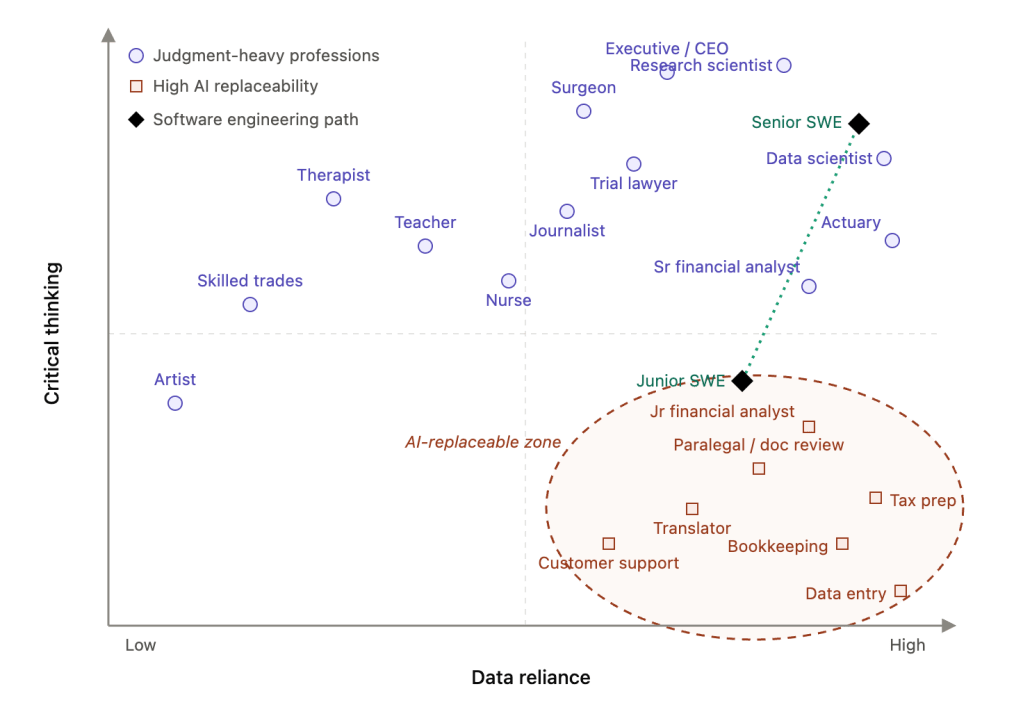
I think as AI gets more powerful, it can start to consume more and more of the job market. However, until AI replaces consciousness entirely, it’s not going to even touch fields like art, music, and areas where it doesn’t really rely on data. AI is getting increasingly better at critical thinking, so higher-level jobs like lawyers will be at risk before artists, in my opinion. However, there’s a third axis which I didn’t bother to plot: how much people rely on the job being done correctly. High-risk fields like medicine can’t really afford to be messed up by an A.I. The accountability problem is very real, and I think it’s going to take a very long time for regulators to decide who even is liable if an A.I. makes an incorrect medical recommendation. I think the field is just too risky for people to trust AI over a person who’s been working on this their whole life.
The next era of thinking
This concept keeps me up at night, genuinely.Things that I’ve needed to spend my time figuring out that are done instantly by a computer are not something I thought I would ever see in my lifetime, especially with a field like software engineering, which for a while has been pretty safe as a career path, I would say. I’ve caught myself thinking less and less when completing tasks at work, outside of work, wherever, because I simply don’t need to. College students are testing at the same level as ten-year-olds in the current generation. This isn’t necessarily their fault. They don’t need to think. The entire education system is modeled upon finishing tasks and completing assignments that now AI can do pretty quickly.
And it’s not even just a rework of the education system that needs to be implemented. It’s a rework of society. Education is ultimately based on what students need to become successful in the real world, but when lots of careers in the real world are going down the drain, then perhaps the skills they need aren’t the same thing as they used to be.
I’ve struggled personally working on projects with AI recently just because of how powerful it is. It’s very easy to assume that AI can do everything, and when you think it can’t, a new model will come out and it will be able to do more.So my work style isn’t just flipped on its head; it’s literally changing every week. The stuff that I’m able to do with AI completely changes. This isn’t something that I don’t think school could ever prepare you for. How is school going to prepare you for an environment where the way you think changes every other day? It feels impossible. It feels dystopian. How do people even expect anyone to stay motivated nowadays or get anything done when there’s a rapid impending doom of AI taking over everything? Even thinking, you hardly need to think anymore. You can just dump all of your questions into AI, and it will 90% of the time give you an answer. You don’t need to try to figure out how to do stuff yourself. That’s how you build neural pathways in your brain, like that’s how you learn, but with AI you just don’t have to for a lot of things.
I am scared for the younger generation, and I hope that the applications of AI at least stabilize, as drastic as they may grow to be. If they stabilize, hopefully we can restructure the education system and just our self-worth to align with the reality of this insanely fast-growing monster that is AI.
The updated take on AI
I’ve had a lot of takes on AI, ranging from “it’s helpful and it’s a tool” to “in this article, it’s going to replace everything.” Let me be clear: when I say, at this second in time, it really only replaces very tedious, mundane jobs, those of which you can see on the graph that I made. However, the technologies in the LLMs I can see barreling out of control, super fast, and extending to much more points on the graph very soon. All it takes is for somebody to make a website that links the data of your profession with the LLM, teaches the LLM how to parse the data like a lawyer would or like a doctor would, or like a teacher would. That’s literally all it takes for careers to get completely hijacked. Simple prompt engineering.
If you’re scared that AI is going to take over the world, I’m not going to say you shouldn’t be. It’s a very real concern. I don’t know much, but I do know that until we figure out the secret to sentience, I think we’re safe. As long as there’s an off button, as long as people still have brains and feelings and thoughts of their own, I think we are safe. I think careers will mold. Software engineering is not what it was even a year ago, and other careers will start to mold over time as well. Some might even change to things completely unrecognizable to you.
If I had AI in college when I was deciding my major, I’m not sure I would’ve gone into computer science. I’m not sure without all the syntax and stuff I loved about programming and having AI just do all that. I don’t know if I’d be motivated to go into this profession. However, I am in this profession and I’ve been in it for six years, so I’m going to keep doing it because I think there are so many unsolved problems, even within software engineering. People use AI differently. People have different opinions on what AI should be used for and shouldn’t be used for, even within the world of software engineering. It’s a highly debatable topic in the community. I don’t think me running away to some other profession is going to help with that, so don’t worry. I’ll still be here, at least while I can.
This post came from feelings of just, I guess, grief. Grief of the job that I thought I signed up for. Grief of the coding best practices that I basically spent my whole career refining. Are those things applicable still? Absolutely, and I think they will be for at least your future, but it looks so much different.
I’m really going to try to work on defining what success means for me, both in my career and on a personal level, because at this current moment in time I feel like everything I do is being replaced by the computer, which definitely doesn’t feel good. I want to really try to believe that there is a point where humanity will prevail, and based off of what I’ve seen in history, it always has. Granted, we’ve never made an intelligent computer like this before, but again, as long as we have the off switch, I think we’ll be okay.


Leave a Reply