The AI boom has been causing the entire stock market to blow one painfully massive bubble. Investors will throw every penny they have at this invisible titan, the alleged “next big thing” – AI. And yet, social media is filled with AI hate, disgust that every app is turning into That Company + AI Bot TM.
Do these business people know something that we don’t, or are they hard coping? Turns out, the answer is probably a mix of both. See, most of the current applications that utilize AI are by business, for businesses (B2B). I’m extremely familiar with this, because this is how Microsoft makes all of its money. Have you ever seen anyone with a Surface in the wild? Probably not. However, have you ever seen an office cubicle run anything except Windows? Again, probably not. This is because Microsoft makes their money by selling to businesses – unlike a company like Apple, who makes their money by selling directly to the people.
The B2B phenomenon is exactly why nobody but my dad uses Bing, the Windows phone was a massive failure, and yet Microsoft is still raking it in. They don’t need to sell you a cell phone – they just sell a company Windows and boom money machine.
How AI works
AI is where things get interesting – because, it’s the first “bleeding edge” technology that I’ve seen in recent history where the primary beneficiary is business. AI is really really good at exactly one thing – making sense of lots of data. That is, quite literally all it is good at. Everything you can think of – the “therapy” you get out of ChatGPT, the “please try our AI chatbot” on every single website you go to nowadays – it’s all the same thing. LLMs (large language models) take patterns from people – words, sentences, contexts – and essentially build a massive prediction model.
Quite literally the simplest example of how all AI actually works is by looking at something called a linear regression model. This was literally the first thing taught to me in my machine learning class in college. Let’s say you have a bunch of data points – for example, you’re trying to figure out how much to sell your house. What you can do is look at all the other houses in the area, and make a graph that is square feet vs the price they’re going for. You’ll end up with a scatter plot. Then, what you can do is calculate (boring math, just adding and dividing) the approximate “line of best fit” through all of those points, like this:
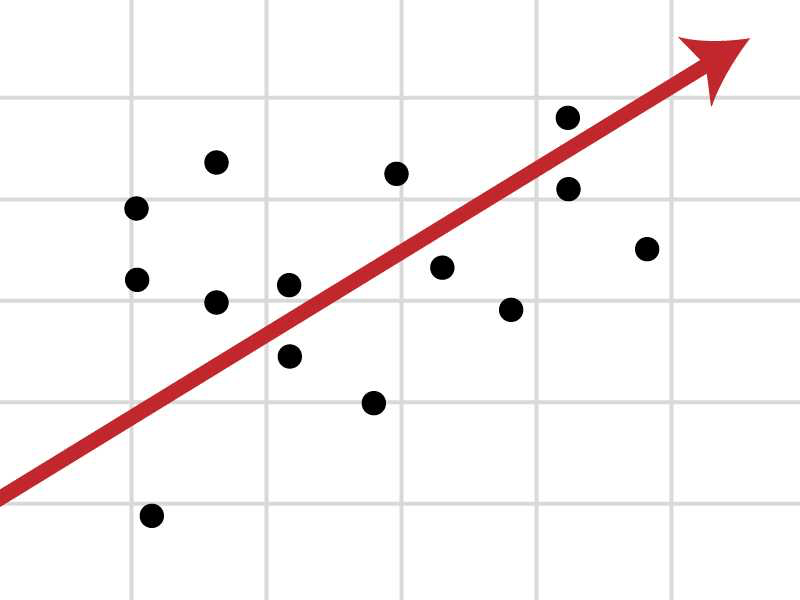
Now, let’s say you have a massive house – you can now figure out approximately how much it’s worth compared to the other houses being sold in the area. The math is extremely simple. And yet, this is all AI really is, except on an astronomically larger scale. AI in its modern form (LLMs) do the same thing with lots of words, sentences, and contexts. It predicts what it “should” say, based on what you give it.
As LLMs grow and get more “correct” about what they “should” say, the accuracy is starting to converge to something we might consider “human” or “useful”. However, while the technology is seemingly impressive, as I’ve talked about in previous entries, the “usefulness” of AI seems to be, to put it bluntly, massively overhyped.
Current strengths of AI
Alright – we have an infinitely intelligent chatbot with all the world’s data trained on – what exactly can that “do” for us? Funny enough, “doing” and “knowing” are very different things. You may know this from talking to someone who is very “book smart”, but not very “street smart”. They might know a lot of things, but are incapable of actually doing things. This is the similar paradigm we’re seeing with these LLMs. They do know a lot, however, it simply does not know how to “do”.
The only reason we are able to “do” as people is, we have brains. Very complex things, billions of neurons, been making connections constantly since we were born. I don’t even think we have the computing power to emulate this. Even if we took all of the computing power in the world right now, maybe we could make one human brain with our current technology? These connections and flexibility are what allow humans to come up with ideas, and perform complex tasks such as creative ones, or critically think.
Because an AI cannot critically think or be creative, obviously it’s not very good at drawing, or writing a script – since it can only emulate other works. It cannot “create”, it can only emulate.
But, that’s not to say AI is all useless. Our entire world is data-driven. Data is how everything is powered. From our Tiktok algorithms to what they put on the Burger King menu, data analysis is the backbone of, really just everything. Analyzing trends, what people like and don’t like, analyzing past events to predict future events (literally the weather app) – this is all data.
Over time, we’ve made programs to parse data. Made data centers, complex software to analyze data and derive valuable insights in virtually every field. The cool thing about data analysis is that it is very easily solved with pattern recognition. Data sets for computers are very easy – usually just a couple parameters, just a LOT of them. And that’s the one thing computers are very good at – going through a lot of things.
Put a computer’s ability to go through a lot of things well and AI’s ability to abstractly infer intent and you have a data analysis machine. The true applications of this we have yet to truly see – at Microsoft we’re working on M365 Copilot, which parses through all of your company’s information quickly and efficiently. It’s able to, within seconds, deliver results looking through Word Documents, Teams Meetings, emails etc. It’s really impressive, and genuinely useful when I can’t remember where my boss told me something months ago.
I’m sure we’ll see plenty of other awesome applications of AI in this sense, it genuinely is the best application of AI in my opinion. Going through massive data sets will always be AI’s greatest strength, since in a sense, that’s literally what AI is to begin with.
Spreading this to more and more applications means making websites more efficient and data retrieval faster and easier. All of this to say, the efficiency of companies using AI will greatly surpass companies not using AI. That is just a fact – the companies using AI will be ahead. It is actually that powerful and actually saves that much time.
Why nobody likes AI
Notice how I said “companies” using AI will be ahead… “companies”. Not, “people”. This is because efficiency boosts are most likely appreciated by businesses. If you can do business faster, you make more money. What do I get from being able to retrieve information from a single dataset more efficiently in my personal life? There’s not ANYTHING that would benefit from that, except maybe my card collection (and even then I’d have to write all of the cards I have down! Boring!)
This just isn’t true for me, I think this is true for everyone. Nobody really cares about going through huge datasets efficiently outside of work except maybe nerds (me included). A smartphone is cool because you can see the chance of rain today before leaving the house. AI is cool because it… can be bad at recommending new furniture?
Seriously, I am really lost on the practical applications of the state of AI right now in consumer. The best application I’ve found for ChatGPT is whenever I try to dip my toes into something I have absolutely no clue about. Think of it like Youtube tutorials, except you don’t have to watch the video – that’s what I use ChatGPT for, and it’s pretty good! The second I have to go one step further though, it’s not that good. The second I ask it a follow up question, it becomes exponentially worse than just talking to a person who knows anything about it. You have to explain it to the AI like it’s a toddler because it cannot understand literally the first thing about human experience.
Besides the lack of practical applications, AI is pretty disliked I think because of how much companies try to push it to people. OpenAI tries to normalize ChatGPT like it’s some kind of friend or something. Microsoft pushes consumer Copilot like it’s your best friend and makes using your computer so much better! No Microsoft, having Copilot on Windows does NOT make the process of opening Steam and clicking on my game any better. I can do that without AI.
So yeah, shilling something that is seemingly useless to people would cause them to be upset. Because, why would they be excited about something that is seemingly useless to them outside their job? Makes sense, I think.
How people would like AI
Of course, I wasn’t going to rant about AI without having a proposed solution, I’m an engineer. Besides the obvious “don’t do the things that people don’t like” that I already pointed out in this article, I think there’s quite a few applications AI can have in the consumer world. Maybe we’ll see someone implement these someday, this is just to give you an idea how AI can actually be useful to you in your real life.
Personal assistant
The most obvious solution to crack consumer AI to me is have a “dashboard” of everything that you care about in your life, and an assistant to follow up with. An actually useful assistant that just, knows your life. Knows your schedule, knows your tendencies, knows everything.
When you are about to leave the house, the assistant would detect you’re about to leave and recommend which coat you should bring outside, and if you should bring an umbrella. The assistant would let you know whenever you’re out of toilet paper and add it to your Costco list. The assistant would know when your floors are getting a little dirty and due for a mop. The assistant would help meal plan for the week with the ingredients you have.
All hypothetical, all requiring various technological advancements, but all examples of how AI could genuinely help out in your life by being an assistant. Assuming the hardware evolves to a certain extent, all of these things could be very possible in the near future. And, I’d argue actually useful.
Vacation planner
This is a big one which I’m surprised nobody’s nailed yet. But just an AI that helps you plan a trip. It knows where you live and how long it takes to drive to the airport, it knows the weather at the destination, it knows how many people are in your family to find hotel rooms. The entire experience could be streamlined, leaving you more time to find fun activities instead of trying to nickel dime the flight and hotel prices (at least, I hate doing this).
Career planner
I know a ton of people are lost in life, especially in their early 20s or so. But, so are a lot of other people, and many people do get out of it! We can really only figure out how by asking people we know – what if you were able to see the different career trajectories of people your age with your experience to help assist you on your way? Sorry this one’s a bit job adjacent… but again, useful!
Musician assistant
“Hey, I want to play this song on [insert instrument], how do I play it? I’m a beginner” – gives sheet music and tutorial. Sure there are tutorials and such on YouTube, but this would be a pretty huge game changer for people getting into music, and even professionals. Seems useful!
Driving assistant
Should I drive further ahead and try to find gas + food in another state, or should I try to find one nearby where gas might be cheaper? When should I leave to optimize traffic patterns? Driving is so unbelievably complicated, especially when you add multiple destinations, multiple people, and gas! Wouldn’t it be cool if your car was just like, “Yeah man, you should drive for like 20 more minutes and the gas is actually way cheaper, so just hold off”?? I think that would be cool. And, it’s not like we don’t have the technology for that!
Conclusion
Even if you thought some of my proposed AI consumer apps were dumb (I’m an engineer, I probably think of bad product ideas), if you even thought one of them would benefit your life even in the slightest, my point is proven. AI has a long way to go – not even in its technology, but in its applications. We’re seeing the epitome of business making things to hike their stock prices in the modern AI era, instead of making things people actually want. I’m no financial expert, but this is very bubble-like to me – I could be wrong (this is not financial advice).
I think these applications will come. Maybe after the bubble pops, but I have faith that someone will pick up on genuinely beneficial consumer AI apps. One thing to be said also – I think there’s definitely a technological blocker here, not in software but in hardware. Collecting all of this data and display of information for assistants like the ones I mentioned would require hardware to change pretty drastically. We should either have our phones just turn on to the “Bring a jacket it’s cold outside” screen, or start shipping out those smart glasses so they can do that instead!
I both agree and disagree with the “AI is the future” sentiment – I think if stuff that actually makes people’s lives better is made, for sure. But this AI stuff we have right now is the future? Sora 2 is the future? Definitely not. It’s a tricky world we live in, but one we’re all going to have to navigate together.
Jared

 foo for thought
Leave a comment